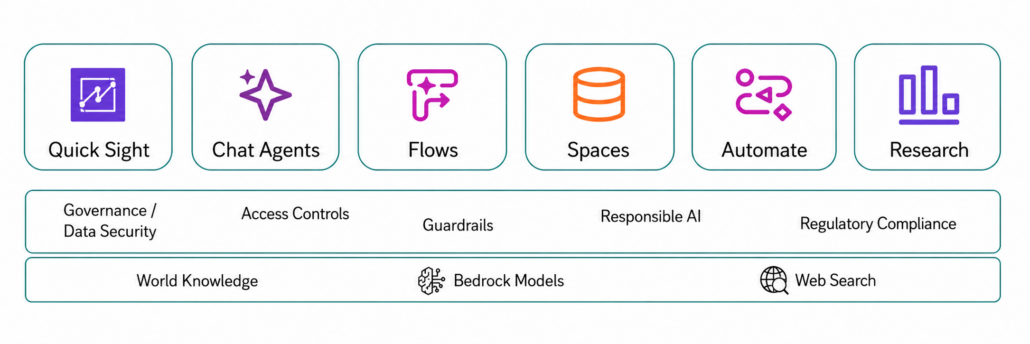
When AWS first introduced Quick Sight, it transformed how organizations visualized and explored their data. For many businesses, it marked the beginning of a new era of cloud native analytics that is fast, scalable, and accessible. Now AWS has taken a far more ambitious step forward with Amazon Quick.

Amazon Quick is a unified AI powered analytics and automation platform that brings together structured and unstructured data, conversational intelligence, research automation, and workflow execution into a single experience. Rather than focusing solely on dashboards, Quick reimagines business intelligence as an active agent driven workspace where insights are discovered, explained, and acted upon in real time.

Built on the foundation of Amazon Quick Sight, Amazon Quick preserves the familiar BI experience while introducing a modern interface and a new layer of intelligence. Users will notice an updated home page with customizable tiles, personalized recommendations, and streamlined access to recent analyses and dashboards. However, the true innovation lies deeper in the platform through capabilities like Spaces and the Research Agent. Together, they shift analytics away from static reporting and toward continuous conversational exploration and execution.

The Integrated AI Components of Amazon Quick
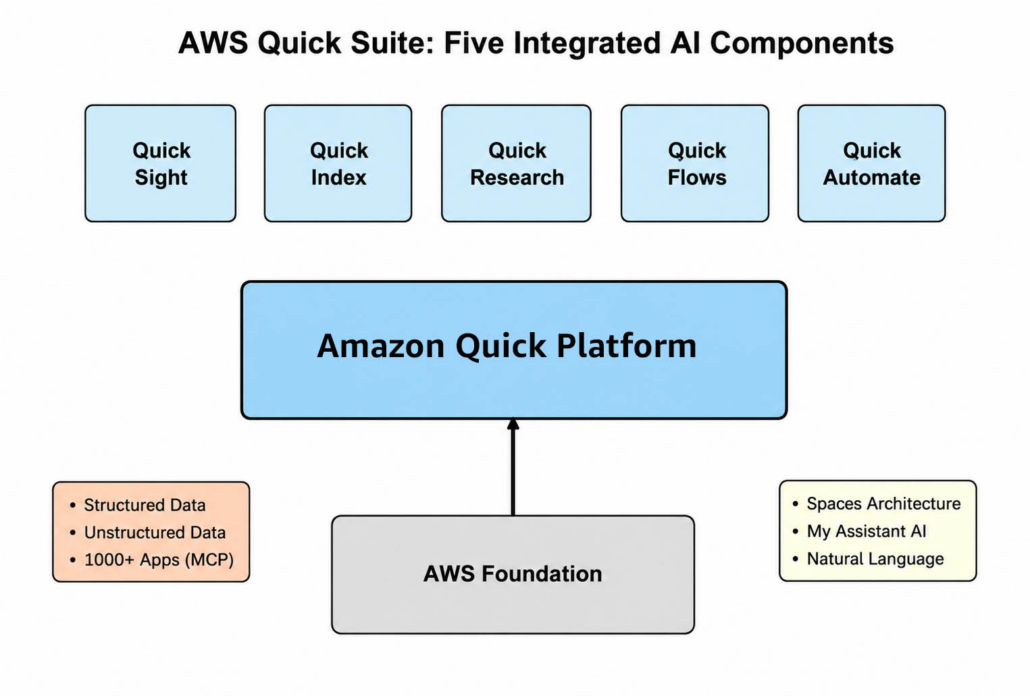
Amazon Quick is built on five integrated AI components, Quick Sight, Quick Index, Quick Research, Quick Flows, and Quick Automate, operating on a shared platform layer. Together, they unify structured data, unstructured content, and enterprise application context through Spaces and natural language interaction, all built on the AWS foundation to ensure scalability, security, and governance.

Spaces Centralized Knowledge Hubs

Amazon Quick Spaces act as domain specific knowledge hubs organized around business functions such as Finance, Operations, Sales, or HR. Each Space serves as an intelligent container where teams can bring together both structured data such as Quick Sight dashboards, Amazon Redshift tables, and CSV files, and unstructured content including PDFs, Word documents, meeting transcripts, and audio summaries.

This unified context allows Amazon Quick AI agents to reason across data types that were traditionally siloed. Instead of switching between dashboards, document repositories, and external tools, users can explore insights within a single conversational environment.

Once data and documents are connected, users interact with My Assistant, Amazon Quick’s built in AI companion. My Assistant understands both numerical data and narrative context, allowing users to ask natural language questions such as “What were the top performing stores this month?” or “Summarize key themes from customer feedback.” Responses can include visualizations, written summaries, and suggested next steps, all delivered within the same conversational thread.

Because Spaces inherit existing permissions and access controls, organizations can safely democratize access to AI powered analytics without compromising security, governance, or compliance.

Amazon Quick Research accelerates Deep Analysis

Beyond interactive conversations, Amazon Quick introduces the Research Agent, an AI powered analyst designed to handle complex multi step research tasks that traditionally required significant manual effort.

The Research Agent can scan across internal datasets, enterprise documents, and external or public data sources to produce comprehensive data backed research papers complete with charts, contextual explanations, citations, and strategic recommendations.

For example, a retailer might ask the Research Agent to analyze long term sales trends, inflationary pressures, private label performance, and supply chain constraints in a single request. What once took teams of analysts several days can now be completed in under an hour, producing a polished report ready for executive review.

Bridging traditional analytics and Generative AI

What truly differentiates Amazon Quick is its ability to unify traditional business intelligence with generative AI in a single coherent experience. Dashboards, datasets, documents, and workflows no longer live in separate systems. Instead, they coexist within a shared context that AI agents can understand and reason over.

Through natural language interactions with My Assistant, users can explore insights without writing SQL, building custom visuals, or navigating multiple tools. The platform interprets intent, validates metrics, generates visualizations, and recommends follow up questions or actions, which dramatically reduces reliance on centralized BI teams and accelerates time to insight.

Amazon Quick also extends beyond insight generation into execution. With Quick Flows, business users can create no code automations using natural language to streamline everyday tasks. For more complex cross system processes, Quick Automate enables enterprise grade multi agent workflows that span applications, APIs, and user interfaces, while still maintaining human oversight where needed.

Because Amazon Quick is deeply integrated with AWS services such as Amazon Redshift, Amazon S3, and Amazon Bedrock, it scales naturally across departments and enterprises. Security, governance, and performance remain consistent with AWS standards, ensuring that organizations can adopt AI driven analytics without disrupting existing infrastructure or compliance requirements.

The next chapter of Business Intelligence

Amazon Quick represents more than an evolution of Quick Sight. It marks a fundamental shift in how business intelligence is experienced and applied. Instead of static dashboards or disconnected tools, Amazon Quick enables organizations to maintain an ongoing dialogue with both structured and unstructured data, supported by AI agents that can analyze, explain, and act.

By combining visual analytics, conversational AI, automated research, and workflow execution, Amazon Quick transforms BI from a reporting function into an intelligent proactive partner in decision making. As organizations move toward AI driven operating models, Quick positions analytics not as an endpoint, but as a continuous embedded capability across the enterprise.

Launched in October, Amazon Quick is now available for organizations to explore. By unifying powerful business intelligence with agentic AI in a single platform, Amazon Quick redefines what is possible for the future of analytics.
Pricing explained

AWS’s latest offering, Amazon Quick, builds on the foundation of its business intelligence engine, Quick Sight — now positioned as a core component within the broader Amazon Quick platform rather than a standalone product. By combining new AI-driven capabilities with its established BI infrastructure, AWS is evolving the platform beyond traditional analytics. This comparison focuses specifically on pricing, licensing tiers, and cost considerations, including recent promotions and infrastructure requirements.

Quick Sight is a business intelligence platform specializing in dashboards, embedded analytics, and SPICE. Amazon Quick on the other hand introduces a wide range of tools to allow users to dive deeper into their data analytics. Amazon Quick includes tools such as chat agents, Quick research, Quick Flows, Quick Automate, and Quick Index. 

Pricing for Quick Sight has not changed and Amazon Quick subscriptions follow a similar structure. Both platforms offer user based pricing with different tiers available for each service. Quick Sight subscriptions begin with Reader and Reader Pro, costing $3/month and $20/month respectively. Reader allows users to view and interact with dashboards, download data, and receive email/scheduled reports. Reader Pro builds upon this by adding Generative BI features such as executive summaries, data stories, and “what-if” scenario analysis. Reader and Reader Pro will allow you to view reports, in order to create them we will need to upgrade to Author and or Author Pro. The Author subscription begins at $24/month and Author Pro has been reduced from $50/month to $40/month (may vary due to region). Author will allow users to build datasets, design analyses, and create dashboards. Author Pro integrates Generative BI features into the dashboard creation process such as dashboard building using natural language.

Amazon Quick pricing follows the same dual tier structure established by Quick Sight. A Professional tier level subscription costs $20/month and the Enterprise subscription costs $40/month. A Professional subscription in Amazon Quick will allow the user to view and interact with dashboards with the Generative BI features built into Quick Sight. In addition to that, the Professional subscription will give you access to further explore your dashboards by using chat agents, Quick Flows, and Quick Research. Each being a different AI tool waiting to be taken advantage of for your data analysis needs. The Enterprise tier builds upon Professional by expanding limits and capabilities across creation, automation, and exploration workflows, making it better suited for teams with higher usage, broader collaboration needs, or more complex analytics use cases. Both Professional and Enterprise subscriptions introduce AI-powered capabilities that require dedicated account-level infrastructure. 

In addition to per-user subscription costs and storage costs, AI-enabled Amazon Quick usage requires a dedicated infrastructure fee of $250 per account per month. Amazon Quick uses Quick Index to store and index documents and other unstructured content that power AI-driven features such as research, chat agents, and document-based analysis. The $250 monthly infrastructure fee includes 50 MB of Quick Index storage. Additional Quick Index storage beyond the included amount is billed at $1 per MB per month. Organizations that plan to index large volumes of documents, knowledge bases, or other unstructured data should factor these ongoing storage costs into their total cost of ownership when evaluating Amazon Quick.
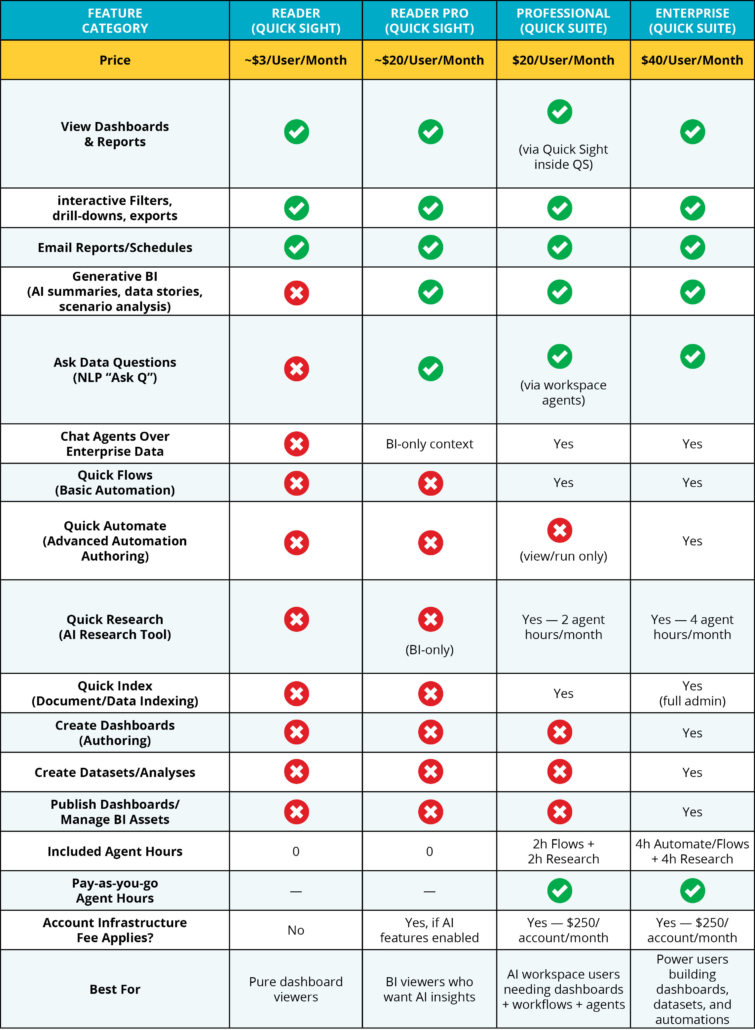
AWS currently offers promotional waivers and limited free trial access for eligible customers evaluating Amazon Quick. Organizations focused solely on dashboard consumption may find Quick Sight Reader or Reader Pro sufficient, while teams seeking AI-driven workflows, automation, and research capabilities may benefit from Amazon Quick Professional or Enterprise tiers.
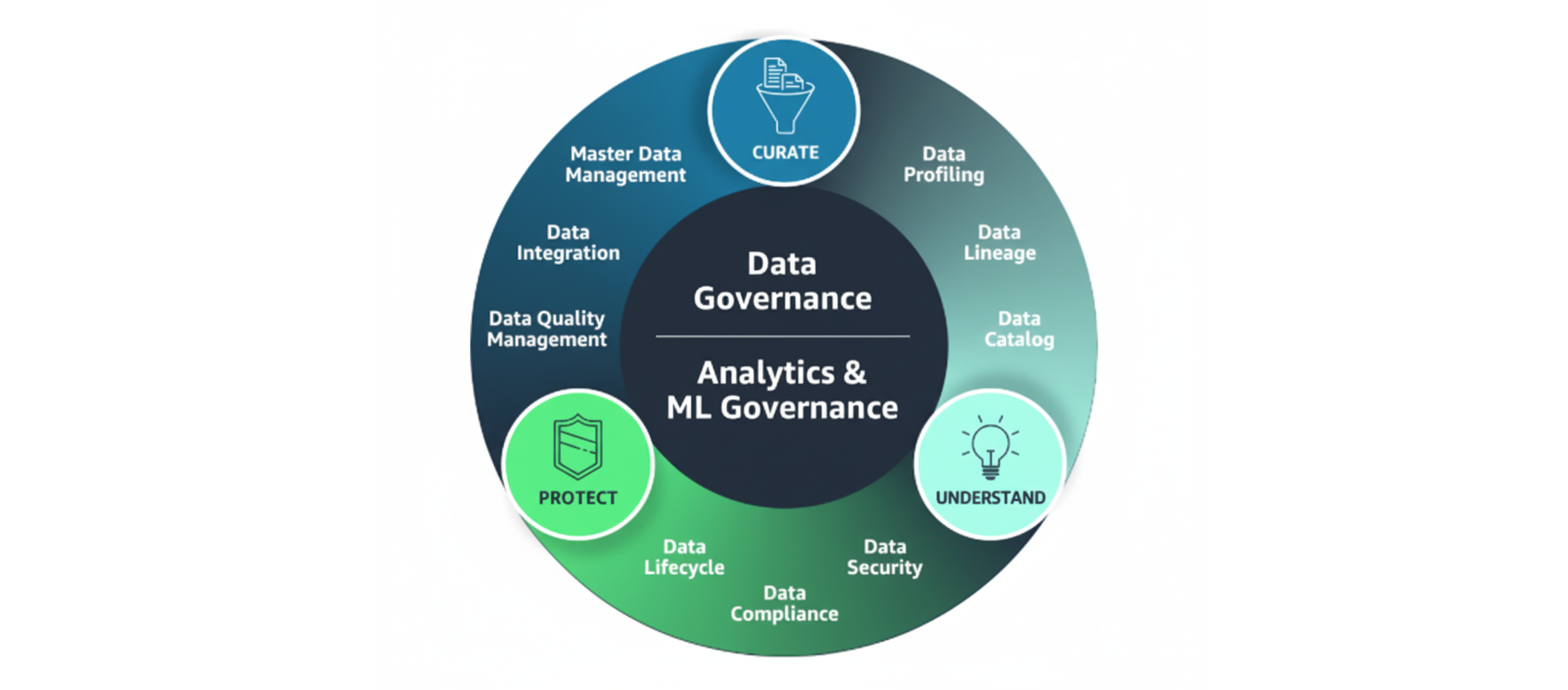
Credit unions have long been pioneers in member-centric banking, building lasting relationships through personalized services and community-based values. Today’s credit unions operate in an increasingly complex regulatory environment with heightened expectations around data privacy and security. Balancing these growing compliance demands within operational constraints while maintaining personalized service presents unique challenges—demonstrating data stewardship to regulators, protecting member privacy, and maintaining member trust through responsible data management.


Data governance is a comprehensive solution to these interconnected challenges, providing the framework to address regulatory requirements, meet evolving member privacy expectations, and strengthen the foundation of member trust that is fundamental to credit union success.

Source: AWS

What Data Governance Delivers


Data governance is the systematic management of data availability, usability, integrity, and security throughout your organization. For credit unions, this means establishing clear policies for how member data is collected, stored, used, and protected—creating the foundation that enables confident decision-making, regulatory compliance, and personalized service.

“Credit Unions leverage the strength of customer intimacy with their members. As business becomes more digital and data-driven, the need to govern that data well becomes even more critical for credit unions, to avoid the risk bad data can impart on this core strategy. Solid data governance mitigates this risk.”

— Paul Hardy, EVP Professional Services & Head of Data Strategy

Immediate Value

Regulatory Compliance: Quickly locate required information and prove compliance during examinations through clear documentation and access controls.  And, be sure to implement regulatory best practices such as:

  • Documentation: Maintain documentation demonstrating program effectiveness
  • Privacy and Security: Stay current with evolving regulations and maintain appropriate safeguards
  • Third-Party Risk: Ensure your governance framework addresses vendor data handling

Member Privacy and Trust: Prevent privacy breaches through appropriate access controls and transparency about information use

Data Quality: Eliminate duplicate records and inefficient processes through standards for data entry and validation

Strategic Decisions: Trust information used for planning through clear definitions and consistent calculations

How To Get Started

  • Establish Data Ownership: Assign individuals responsibility for data domains—member information, loans, financial reporting. These stewards must understand business requirements and work with IT teams to ensure proper system implementation.
  • Document Current State: Inventory what data you collect, where it’s stored, and how it’s used. Identify gaps in quality, access controls, and retention policies to prioritize improvements.
  • Implement Policy Framework: Develop written policies for data collection, use, sharing, and retention that align with regulations and support operations. Include quality standards, access controls, retention schedules, and escalation procedures.
  • Collaborate: Third party experts can provide perspectives on best practices from both inside and outside the industry.

Measuring Success

Track both operational metrics (data quality scores, issue resolution times, examination findings) and strategic outcomes (compliance scores, member satisfaction, operational efficiency).

Bottom Line

Effective data governance is an ongoing commitment to responsible data stewardship. Start with fundamental practices within current resources, then build capabilities as your program matures. Credit unions investing in data governance today will be better positioned to serve members, satisfy regulators, and compete effectively. Your members’ trust and long-term success depend on it.

(February 25, 2026: Amazon Q has been incorporated in Amazon Quick, and is now referred to as Amazon Quick Research.)

Technology has evolved significantly from dial-up connections to cloud computing and Artificial Intelligence (AI). As a result, businesses must now adopt AI solutions that push their operations beyond using traditional tools. One such solution is Amazon Q Business, an AI framework that will act as your central knowledge repository. Gone are the days of waiting for multiple responses from multiple departments. By incorporating your various data sources, users can access the answers they need faster than ever. Amazon Q Business is more than just the next AI chatbot; it is your tactical ally in making data-driven decisions. Whether you’re an expanding new company or an international corporation, Amazon Q Business presents the ability to adjust and improve your procedures. This blog will explore what makes Amazon Q Business unique and how it differs from the usual AI tools. We’ll also discuss why it can change work methods and decision-making in many areas.


Understanding Amazon Q Business

Amazon Q Business is not just a regular chatbot or digital assistant but a highly advanced AI system that combines complicated business environments. It can quickly ingest data from business platforms such as Salesforce, Slack, and other personalized CRM systems, decreasing interference and eliminating the need for intense reorganization. Amazon Q Business provides over 40 fully managed connectors to match current workflows. It will learn, adapt, and develop to better fulfill your company’s specific demands. Instead of providing automated or common answers, this service uses sophisticated machine learning and natural language processing to grasp the context, recognize knowledge areas, and give recommendations based on the integrated data. All that data is processed securely and distributed to users based on their level of access. The Q platform takes several steps to keep your data safe by invoking several preventive measures. Those measures include infrastructure security, data processing controls, and access control. Q Business’ main advantage is that it can constantly learn from its interactions and internal systems. It can speedily gather sales data, create precise predictions, and examine immediate customer feedback across several platforms.

Key Features of Amazon Q Business

1. Enterprise Data Integration

Amazon Q combines a single environment by providing over 40 fully managed pre-built data connectors and the ability to create custom data connectors. This includes well-known platforms like SharePoint, Google Workspace, and Amazon S3. The connections let employees get information from all company resources using one interface while the system keeps current security rules and user rights intact. The platform updates content instantaneously, ensuring replies are always based on the most up-to-date available details.

2. Intelligent Task Automation

Task automation is changing the way regular business processes are handled. Employees no longer need to switch between different applications; they can explain their requirements in everyday language, and Amazon Q will perform the required task. Over 50 pre-built actions are available to quickly automate tasks for some of the most popular third-party applications.

3. AI-Powered Content Generation

The system’s ability to create content goes beyond condensing lengthy documents or highlighting essential points and tasks. It uses context and company data to create related, brand-aligned content for various business requirements. Whether writing professional emails, making presentation plans, or producing reports from data, Amazon Q follows the company’s tone and style rules.

4. Knowledge Management Hub

Amazon Q, acting as your central repository of knowledge, alters how organizations manage and reach their institutional comprehension. It links various sources of information to create a single base of expertise that simplifies employees’ search process for the precise data they require. By relying on integrated data, Q comprehends context and relationships amid diverse information. By incorporating your sources, Q Business will deliver relevant and accurate responses. Best of all, you can share the built-up knowledge base with verified third-party software using an API.

5. Security-First Design

Safety is built into every part of Amazon Q’s system design. The platform is SOC compliant and smoothly integrates with companies’ current authentication methods. Those who manage the platform have precise control over content accessibility and can establish rules for filtering content. The system keeps thorough records of audits and assures that data protection rules are met, as it clarifies how AI produces and utilizes content.

Streamlining Business Operations with Amazon Q Business

Amazon Q Business improves and simplifies every part of the business. It provides new employees with a personalized start-up experience, allowing them immediate access to critical information like product papers and company updates. This knowledge pipeline established by Q Business increases the speed at which an employee becomes part of the team and lowers the downtime required to reach full productivity. Integrating different third-party applications on this platform is straightforward, ensuring employees can readily access information dispersed across your company tools. This eradicates the disruption in the work process brought about by changing between platforms and clicking through menus.

Amazon Q Business allows managers to automate workflows and add standard operating procedures without coding knowledge. Businesses can make smooth processes that change according to their growing needs by using present resources like videos, documents, and SOPs. Harnessing the potential of generative AI companies can increase operation efficiency and reduce reliance on technical resources. The combination of gen AI and the Q knowledge base will equip company personnel to create high-quality and consistent individualized client materials. The Amazon Q platform saves time and encourages more substantial relationships with clients.

In a time when data-based insight and fast decision-making can decide who leads the market, Amazon Q Business is there to help build your strategic edge. It utilizes generative AI, smooth integrations, and a scalable architecture to enhance how teams work together and create influence significantly. As you build up your knowledge base, Amazon Q Business becomes your one-stop shop for simplifying internal procedures, gaining more knowledge from each client communication, or laying the groundwork for upcoming AI advancements. It is powerful due to its flexibility in adapting to the changing needs of everyday businesses.

Do you want to share your general inquiries or experiences related to Amazon Q Business or AI-driven solutions? Don’t hesitate to leave your comments and thoughts. Your point of view dramatically contributes to our comprehension of how progressive AI tools can continue to change the business environment.

Ready to transform your customer experience measurement program with AI? Contact Ironside to learn how we can help you achieve operational excellence and deliver enhanced value to your client: [email protected]

The introduction of Amazon Q features a powerful generative artificial intelligence (AI) assistant designed to analyze business trends, assist in software development, and maximize the potential of a company’s internal data. Amazon Q connects with a diverse range of AWS services. One of Amazon Q’s flagship services is Amazon Q Business. Another key Amazon Q integration is with the powerful business intelligence (BI) tool, Amazon Quick Sight. In this post, we will delineate how these two specific AWS services are enhanced by their integration with Amazon Q.

What is Amazon Q?

Let us first understand Amazon Q, the foundational layer that integrates with both Amazon Q Business and Amazon Q in Quick Sight.

Amazon Q is a platform developed by AWS that harnesses generative artificial intelligence (AI) to enhance various business processes. Amazon Q is capable of generating code, creating tests, debugging code, and has multistep planning and reasoning capabilities that make it easier for employees to get answers to questions across the entirety of business data—such as company policies, compliance requirements, product offerings, performance metrics, code bases, employee information, and more—by connecting to enterprise data repositories that summarize the data logically, analyze trends, and facilitate dialogue regarding the information.

Amazon Q Business

Amazon Q Business is a fully managed, generative-AI powered assistant that you can configure to answer questions, provide summaries, generate content, and complete tasks designed with enterprise-level security  in mind. It allows end users to receive immediate, permissions-aware responses from enterprise data sources with citations, for use cases such as IT, HR, and benefits help desks. Amazon Q Business also helps streamline tasks and expedite decision-making with no data exposure to public models. You can use Amazon Q Business to create and share task automation applications, or perform routine actions like submitting time-off requests and sending meeting invites.

Amazon Q in Quick Sight

Amazon Quick Sight offers a comprehensive range of features comparable to those of leading business intelligence tools. However, the integration of Amazon Q provides a distinct competitive advantage. Having Amazon Q as the generative AI assistant on top of Amazon Quick Sight simplifies data exploration for business users. With the new Q&A experience in Amazon Q in Quick Sight, users receive multi-visual responses complete with data previews, empowering them to move beyond the mundane and manual processes of traditional dashboard insights.

This functionality streamlines the process of presenting and generating data analyses and reports, facilitating more effective decision-making and strategic initiatives. Stakeholders do not need to possess in-depth knowledge of the data query language or the dashboarding tool to create specific dashboards. Instead, they can simply ask Amazon Q for their desired output, and it will efficiently sift through the data, select the most suitable and presentable visual, and generate it in Amazon Quick Sight in a matter of seconds.

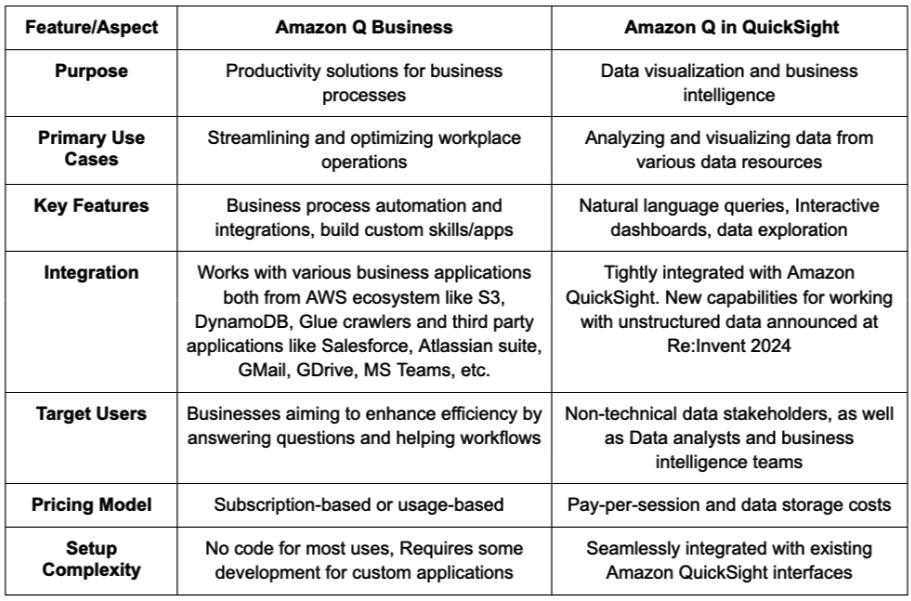
Let’s summarize the key differences:

In summary, Amazon Q Business and Amazon Q in Quick Sight serve distinct but complementary roles within the AWS ecosystem. Understanding their key differences allows organizations to leverage these tools effectively. While both are powered by generative AI capabilities through Amazon Q, Amazon Q Business enhances productivity in business tasks by serving as an excellent AI assistant, whereas Amazon Q in Quick Sight is used for advanced data visualization, rapid reporting and dashboarding, and analysis across various data sources.

Here are a couple links to the latest AWS announcements:

Amazon Q Business Insights Databases Data Warehouses Preview
Query Structured Data From Amazon Q Business Using Amazon Quick Sight Integration